
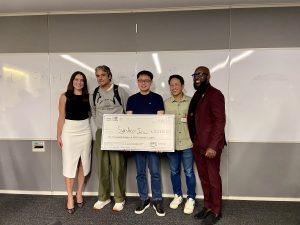
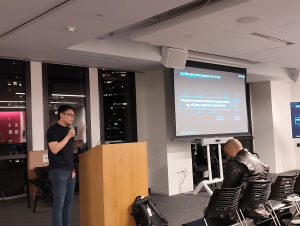
SOUTH SAN FRANCISCO, CA, October 7, 2026 — Synlico Inc. won second place at the 2026 AWS × NVIDIA AI Pitch Competition, held on October 6 during SF Tech Week. Dr. Jingwei Lu, Ph.D., founder and CEO of Synlico, represented the company and introduced Synlico’s causal AI-led decision-making platform grounded in real patient biology.
Hosted by AWS Startups and NVIDIA, the competition brought six finalists to San Francisco from a pool of more than 100 qualifying applications. Each founder had three minutes to present, followed by a three-minute question-and-answer session. Judges from AWS, NVIDIA, and venture capital firms assessed the companies’ technical depth, innovation, business potential, and readiness to bring their solutions to market.

Synlico is developing SynCausal™ – Patient-Native Causal AI for Therapeutics Decisions. Just as engineers use simulation to test designs before building, Synlico is working to bring that approach to therapeutics. The platform combines single-cell data from primary patient samples with causal modeling to investigate how biological interventions may affect patients and cell types, helping scientists determine which biological intervention is worth pursuing, why it may work, and in which patient contexts the hypothesis is most credible. Synlico’s ambition is to make validated causal simulation part of how therapeutic designs are evaluated across R&D, connecting computational predictions with experimental evidence and defined decision criteria.
“Being selected to pitch was already encouraging, and we’re grateful for this recognition and for the opportunity to share what we are working on at Synlico,” said Dr. Jingwei Lu. The award follows Synlico’s recognition earlier this year in the Nebius AI Discovery Awards 2026, where it received a BioPharma Honorable Mention and was among the top 10 companies in its category.
Synlico is a South San Francisco-based company developing patient-native causal AI for therapeutic decision-making. Its SynCausal™ platform seeks to build a computational layer that represents disease in its native patient, cellular, and tissue context, then uses virtual biological interventions to discover and prioritize disease-driving targets, uncover novel mechanisms, and evaluate how those mechanisms may respond to therapeutic modulation. For more information, visit www.synlico.com.